
A Kanawha County chemical plant where two employees died and four others were critically injured in April after a highly toxic hydrogen sulfide gas was released did not require workers to wear respirators while decommissioning the facility, according to a report released Thursday by the U.S. Chemical Safety Board.
The incident happened around 9:31 a.m., April 22 at Catalyst Refiners Inc. in Institute, West Virginia.
Employees at the plant told investigators that because the facility was transitioning from normal production to decommissioning, workers were not required to wear respirators, and the company did not provide personal gas monitors to workers or contractors, the report said.
Chemical Safety Board investigators found four full-face respirators at the facility, but they were not equipped with filters that would protect against hazardous gases such as hydrogen sulfide, the CSB said.
“This tragic incident underscores the need to have clear procedures and safely manage the serious chemical hazards that can arise during facility decommissioning,” CSB Chairperson Steve Owens said in a news release. “Although the CSB’s investigation is still ongoing, we are concerned that Catalyst Refiners did not require employees to wear respirators during decommissioning and also never provided or required workers to use personal gas monitors that might have alerted them to the presence of the highly toxic hydrogen sulfide gas.”
In a statement Thursday, Ames Goldsmith, owner of the facility, said it appreciates the assistance of the Chemical Safety Board and Hazard Investigation Board and other agencies as they investigate the deadly incident.
“We have reviewed the CSB update and understand it reflects the significant efforts of the CSB to date in its investigation,” the statement said. “As the CSB works toward a final report, we will continue to cooperate fully with its investigation, as well as with all other agencies involved. Our thoughts are always with our Catalyst Refiners colleagues and their families.”
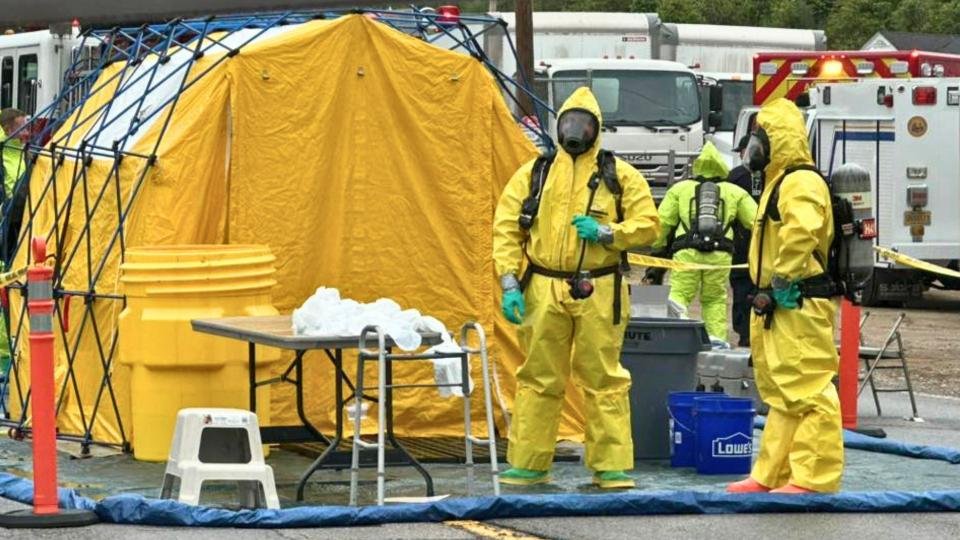
After the incident, 18 personnel — including seven first responders — were decontaminated and transported to local medical facilities for evaluation, according to the report. Twenty-two personnel, including four responders, were decontaminated at the site.
On the day of the incident, plant employees pumped roughly 80 gallons of A-50 and 275 gallons of M-2000A from their storage containers into a wastewater receiving tank, according to the report. Then they started pumping diluted nitric acid from a tote into the same tank.
As the nitric acid was being pumped into the wastewater tank, workers observed a chemical reaction occurring and a fog forming over the tank. The employee operating the pump stopped the flow of nitric acid into the tank. The employee went outside to get some fresh air, passed out and then regained consciousness.
A supervisor was notified about the issue with the chemicals, approached the tank area and also lost consciousness, the report says.
Two more employees also entered the area to assist. One of these employees pulled the unconscious supervisor away from the tank area. The supervisor recovered, but the employee who had come to the supervisor’s assistance, as well as the one who also had entered the area, were overcome by the gas emitting from the tank and later died, the report says.
The facility was used to manufacture silver catalyst. The incident caused a shelter in place for residents in the area.
West Virginia Department of Environmental Protection’s Environmental Enforcement teams also launched a full investigation into the facility, the state announced after the incident.
The Chemical Safety Board is continuing to investigate the deadly incident, it said in the report. The board does not issue fines or safety citations, but makes safety recommendations to companies, labor groups and regulatory agencies.
Lori Kersey is a reporter for West Virginia Watch, which is part of States Newsroom, a nonprofit news network supported by grants and a coalition of donors. West Virginia Watch maintains editorial independence. Contact Editor Leann Ray for questions: info@westvirginiawatch.com.